Summary
For a while now I have been thinking I would like to use my Nikon Z50 camera with its own lenses to do some wide sky astrophotography, and to take with me on trips because that is not possible with my telescope. While the term "Telescope" is typically used for narrow sky astrophotography, the term "Tracker" or "Star-Tracker" is typically used for wide sky astrophotography. The widest angle I can do with my Meade LX90 8" telescope is 1.120° wide by 0.747° high. That's OK for the Moon which is about 0.5°, but that's about it on size. Constellations are larger than that. The Milky Way is much, much larger than that, and can be horizon to horizon with good seeing conditions. This article describes the equipment that I will be using for my "Tracker", or wide sky astrophotography.
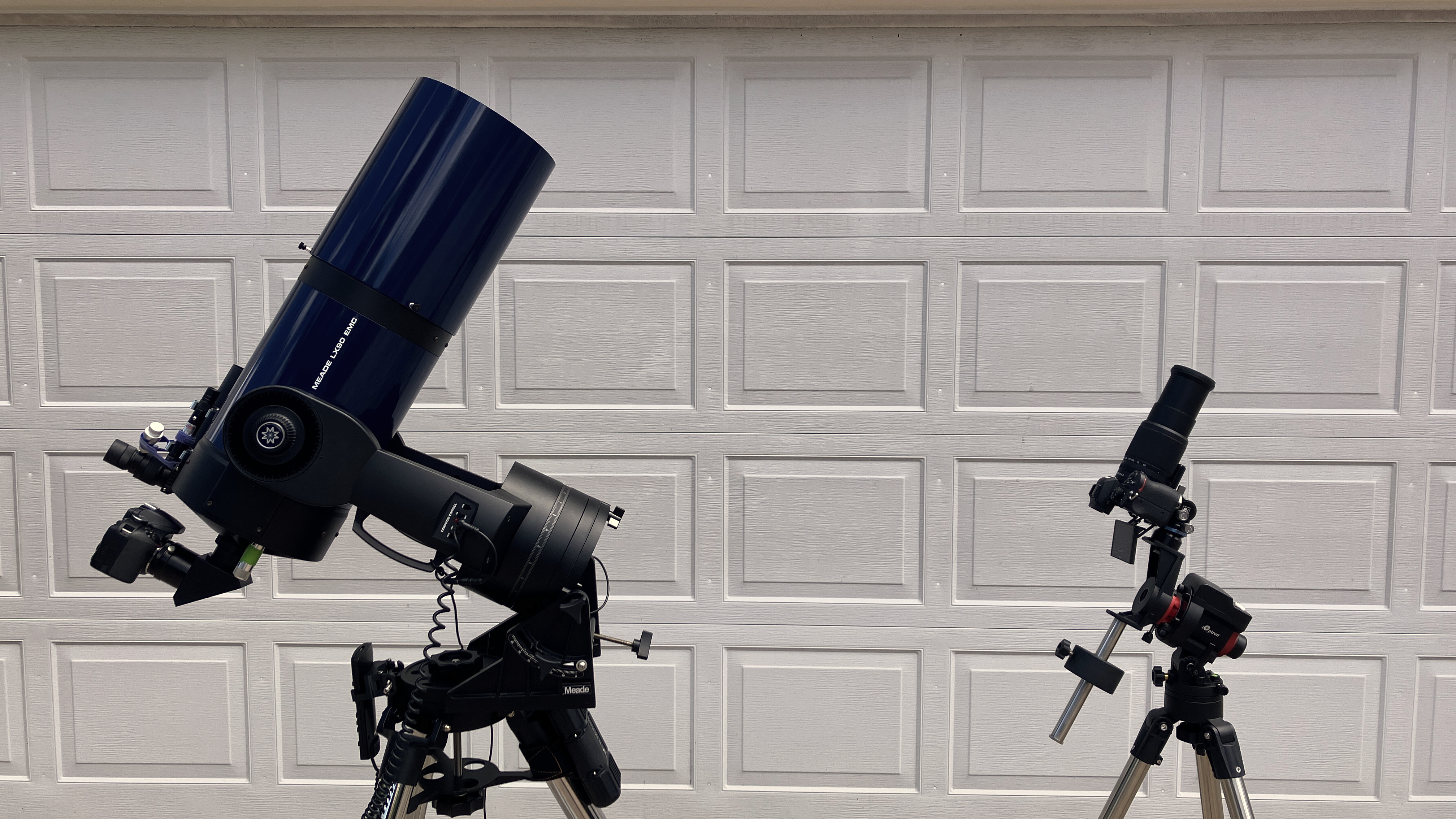
Meade LX90 8" Telescope on the Left. Tracker on the Right.
Both Are Pointed at the Sun which Is on the Celestial Equator Today (First Day of Spring).
My telescope is a Meade LX90 8" telescope mounted on an equatorial wedge and that is mounted on a heavy tripod. That total weight is about 60 pounds. When I was younger I could carry the entire assembly walking sideways a small step at a time, a crab walk. But now that is not possible, I have to use automobile dollies under the tripod legs to move it around. As a result I will not be taking it into the field. I would like to do some things at other locations, though. That is one reason I have a Tracker. The entire Tracker as shown, with Tripod, iOptron SkyGuider Pro, DEC Bracket with Counterweight, Pan and Tilt Head, and Nikon Z50 Camera with 50-250 mm Lens, weighs only 15.6 pounds.
In addition, my telescope is limited to a 1.12° by 0.747° field of view. Even at home, I would like to do some wide sky work. That's another reason for a Tracker. I already have the camera and lenses, all I am missing is a sidereal drive with an equatorial mount. I already have a suitable tripod.
Camera for Tracker
My primary camera these days -- actually I have ten cameras (what can I say, I love cameras) -- is a Nikon Z50. It is a mirrorless camera with a 5568 x 3712 pixel sensor. DX means the APS-C CMOS size, which is about 2/3 of the full frame (35 mm) size. That means that the field of view will be equivalent to a full frame focal length 1.5 times greater.
Lens for Tracker
The "standard" lenses for the Z50, which I have, are a wide angle zoom (Nikkor Z DX 16-50 mm f3.5-6.3) and a telephoto zoom (Nikkor Z DX 50-250 mm f4.5-6.3). I also have the Nikkor Z DX 18-140 mm f3.5-6.3 zoom lens which I use for virtually all of my normal photography. The field of view varies from 66° by 46° at 18 mm to 9.5° by 6.5° at 140 mm. I doubt I will use that lens very often in my tracker setup, though. It is not wide enough for wide sky views and it is not narrow enough for some of the deeper sky views. For reference, the Meade LX90 8" telescope with the Z50 using the Reducer Lens is 1000 mm focal length.
50-250 mm at 250 mm on Left, 18-140 mm at 18 mm on Z50 at Center, 16-50 mm at 16 mm on Right
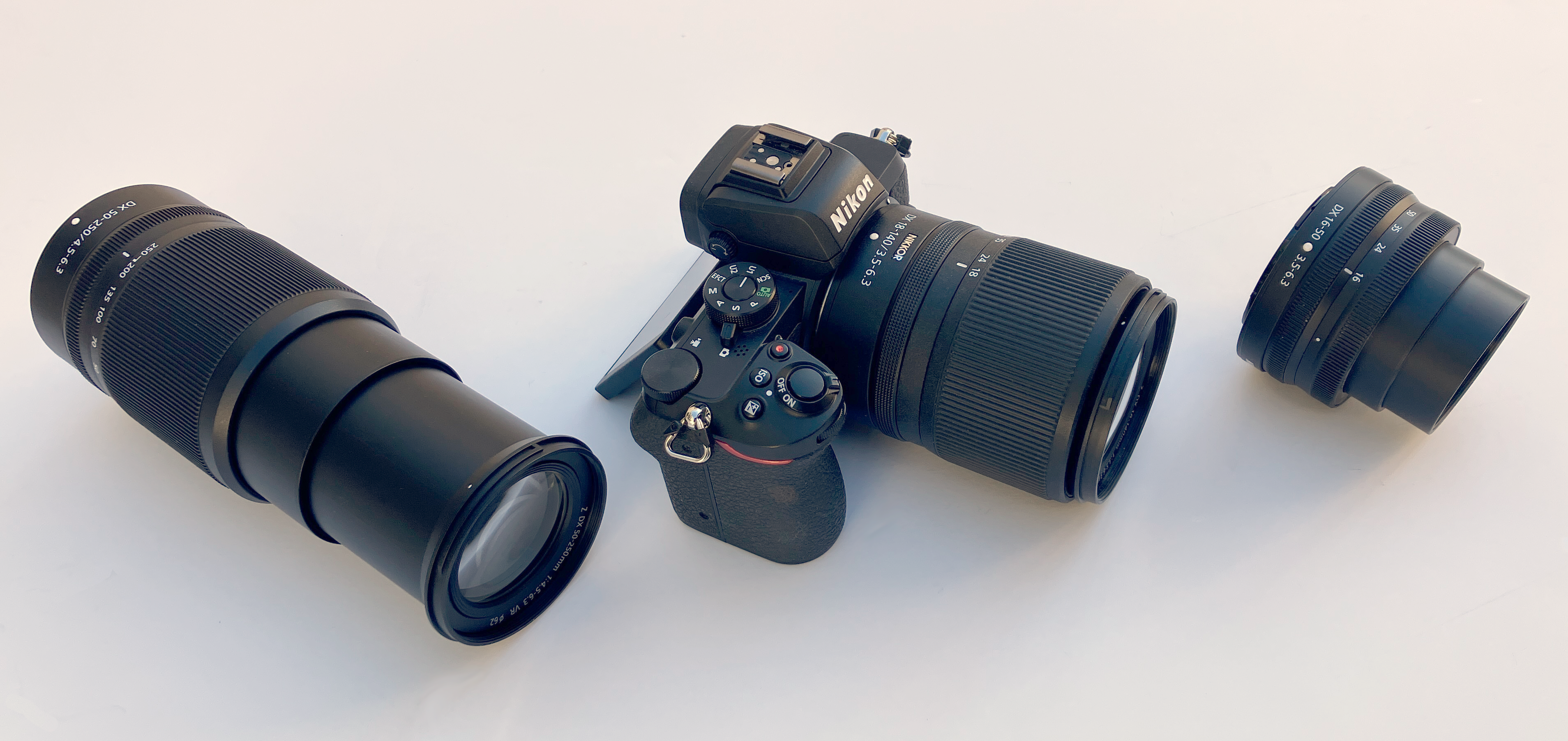
The wide angle zoom is the Nikkor Z DX 16-50 mm f3.5-6.3 zoom lens. Its widest field of view is 74° by 53°. This is wide enough to capture the entire constellation Ursa Major but is not wide enough to capture the constellations Hydra or Virgo. It is not wide enough to capture some of the spectacular wide views of the Milky Way.
The telephoto zoom is the Nikkor Z DX 50-250 mm f4.5-6.3 zoom lens. Its narrowest field of view is 5.4° by 3.6°. This is smaller than any of the 88 constellations. It can capture some of the larger Asterisms, though, like Orion's Belt (2.7°), The Pleiades (1.8° by 1.8°), the Coat Hanger (1.5°), and Kemble's Cascade (2.5°). Note that my Meade LX90 8" telescope with the Z50 and the Reducing Lens (1.12° by 0.747°) cannot cover any of these Asterisms in a single photo.
For reference, the Big Dipper would require a 50 mm lens on the Z50. Both the 16-50 mm and the 50-250 lenses can do this. Capturing the entire constellation Orion would require a 35 mm lens which the 16-50 mm lens can do.
The combination of the 16-50 mm and the 50-250 mm can cover much of the wide sky astrophotography I might want to do. I have an older full frame 14 mm super wide angle lens (81.7° by 59.3°) and an older full frame 300 mm lens (4.5° by 3°) that I could use with my Z50 and my Nikon FTZ Adapter, but they become a bit awkward. I am also considering that I might purchase the Nikkor Z DX 12-28 mm f3.5-5.6 zoom lens ($337) and have 86° by 63° field of view. Or I could get the NIKKOR DX 10-20mm f/4.5-5.6 ($487) and have 97° by 74°. Or I could get the Nikkor DX 10.5 mm f2.8 Fisheye ($789), which would cover the entire sky. I should point out that the maximum view of the sky I have from my sidewalk, which is more than I have in front of my garage where I normally work, is only about 140°. Nonetheless, the only lens that would cover that entire view is the Fisheye.
Table Showing FOV for Telescope and for Tracker with Various Lenses
| Meade LX90 8" with Z50 | Hor FOV | Vert FOV | Diag FOV | Cost |
|---|---|---|---|---|
| Meade / Barlow Lens / Z50 (~5000mm) | 0.223° | 0.149° | --- | --- |
| Meade / Prime Focus / Z50 (~2000mm) | 0.559° | 0.370° | --- | --- |
| Meade / Reducer Lens / Z50 (~1000mm) | 1.120° | 0.747° | --- | --- |
| Tracker Z50 with Lens | Hor FOV | Vert FOV | Diag FOV | Cost |
| Z50 / 50-250mm @ 250mm | 5°26' | 3°38' | 6°30' | --- |
| Z50 / 16-50mm @ 16mm | 72.5° | 52.3° | 83° | --- |
| Z50 / 14mm | 80.2° | 58.5° | 90° | --- |
| Z50 / 12-28mm @ 12mm | 88.6° | 65.5° | 99° | $337 |
| Z50 / 10-20mm @ 10mm | 99.1° | 76.3° | 109° | $487 |
| Z50 / 10.5mm FE | 147.0° | 98.0° | 180° | $789 |
I could do all my wide sky astrophotography without a Tracker, but I would be limited to short exposures to avoid star trails due to the constant motion of the sky. There is a rule of thumb, the "Rule of 500", that the exposure time should be no longer than 500 divided by the focal length of the lens on a full frame camera. With my 250 mm lens, that means the maximum exposure would be 2 seconds on a full frame camera. However, the DX format means that the effective focal length is multiplied by 1.5 or that the exposure time from the calculation will be limited to 2/3 of the calculation. That means 1.3 seconds maximum on my Z50 with my 250 mm lens. And with the high pixel count of cameras today, that exposure is probably too long. So maybe I should limit exposures to 1 second, and call it the "Rule of 250". To be able to make longer exposures, a sidereal mount is required.
So, I bought the iOptron SkyGuider Pro EQ Camera Mount. The motor drive is only for Right Ascension, or for tracking stars. To make it point farther north or south, I must manually set the Declination. With my Meade LX90 having a motor drive for Declination borders on a requirement (for a GoTo function it is a requirement). With the high magnification it is very difficult to manually set the Declination. With my Tracker, though, the magnification is lower and thus not too difficult. The iOptron SkyGuider has a built-in Polar Scope making polar alignment easier than it is on my Meade LX90.
Tracker on Tripod with Z50 and Lens Set to 250 mm while Looking at the Sun
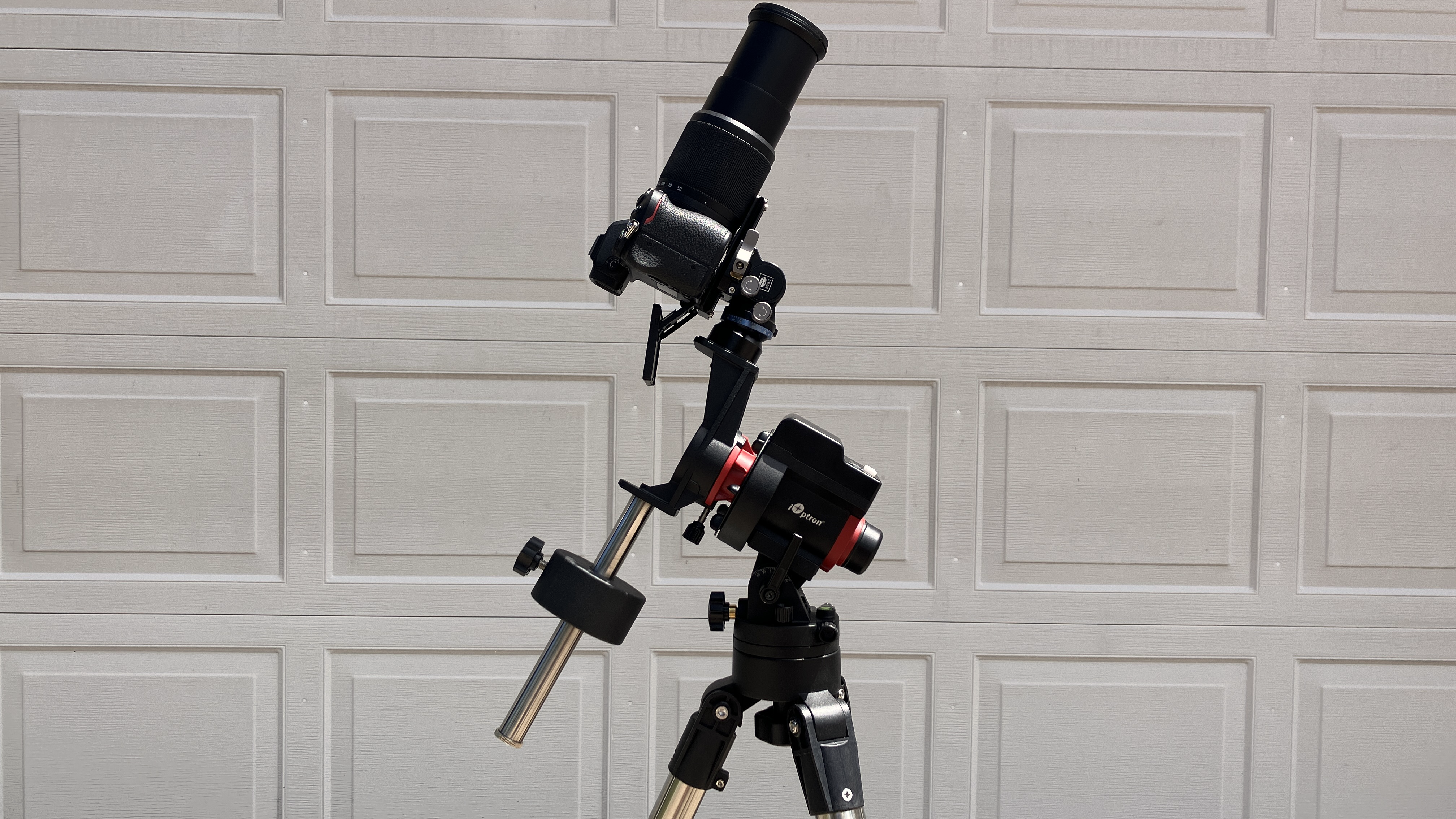
For my normal photography, I use the Sirui ST-124 tripod with the KV-10 pan and tilt photo head.
With the Tracker, I use the same KV-10 pan and tilt head on the iOptron DEC Mounting Bracket with Counterweight. This is all mounted on a 1.25" iOptron Tripod. With this setup I can use the KV-10 Pan to rotate the camera to the northern hemisphere or the southern hemisphere and lock the Pan Lock, using it only for that single purpose. Then, looking south, I can use the Tilt to lift the camera to the celestial equator or down to the southern horizon. When looking north I can use the Tilt to lift the camera to the celestial equator or down to the north celestial pole. I have a small amount of overlap at the celestial equator.
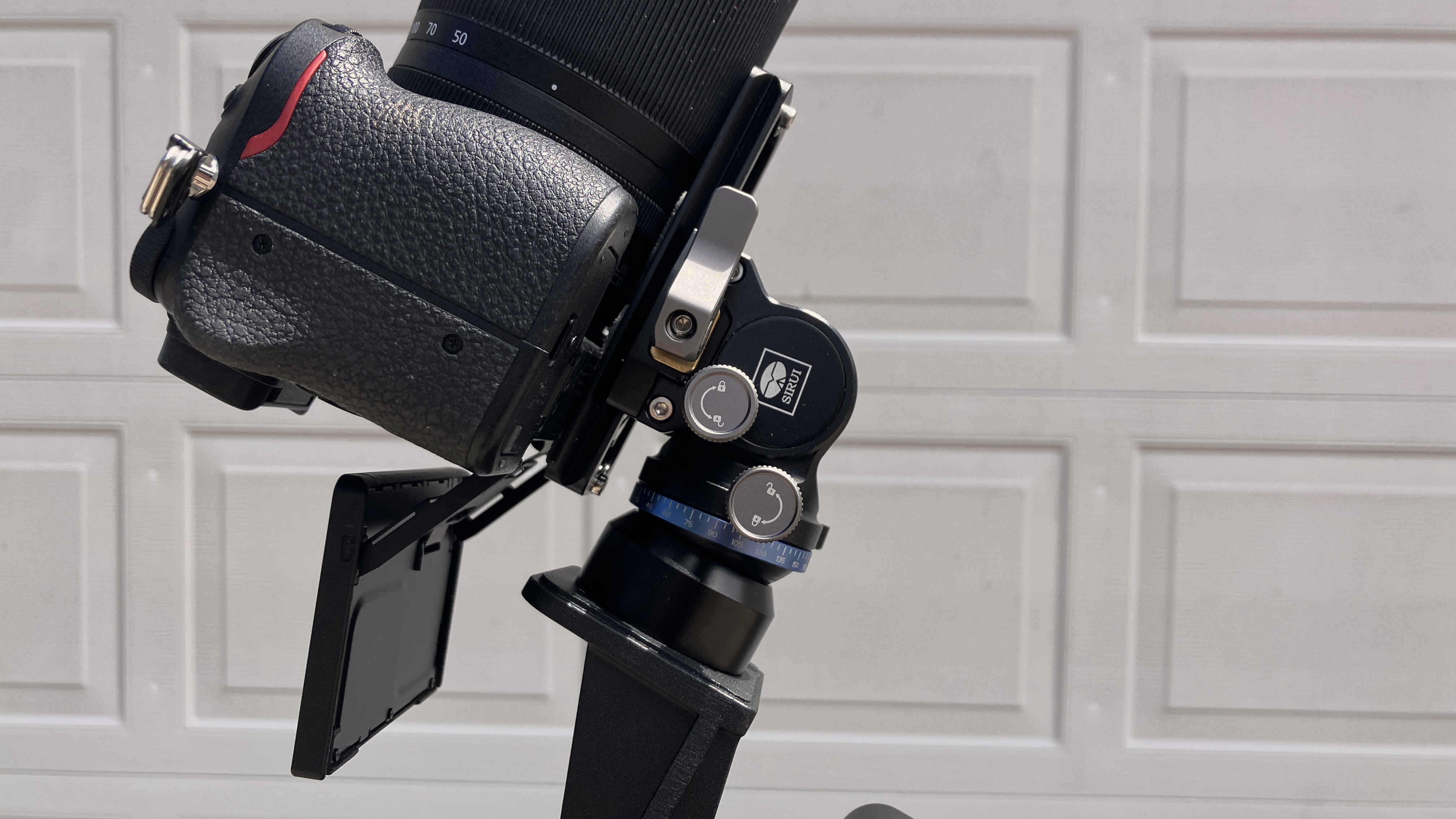
The next picture is a closeup of the Pan and Tilt Head. It is made by Sirius and is the KV-10 model. The lower silver knob is the Pan setting lock which will remain locked except when switching betweeen north and south. The upper silver knob is the Tilt setting lock which will be used to lock the camera on a star or planet. Normally the Pan and Tilt Head has an arm for panning and tilting the camera coming to the back and below the camera, but I removed it because it is in the way more than it is a help.
Tracker on Tripod with Z50 and Lens Set to 250 mm while Looking at the Sun
Suppose I want to look at one of the larger planets, like Jupiter. I would set the tripod pointing north and use the Polar Scope looking at the North Star to position it accurately. Then I would loosen the clutch on the Right Ascension on the iOptron and the Declination (Tilt) locking knob on the KV-10 and move the camera to look at Jupiter. Then I would tighten the clutch and knob. The sideral motor will then keep the camera centered on Jupiter by rotating toward the west as Jupiter moves to the west. A time exposure would not have any smear, or "star trail". If I want to look at something else, I would loosen the clutch and knob, move the camera to look at the second object, then tighten the two.
by Robert Hopkins
21 March 2026